


The character who never acts
When design takes the stage
In the Sixties, when radios and televisions were still objects to be pushed into a corner of the living room, Brionvega made the opposite choice. It called on architects and designers, Marco Zanuso and Richard Sapper, Achille and Pier Giacomo Castiglioni, Mario Bellini, and asked them to give listening a form. The result was objects that did more than work: they occupied a space, defined it, gave it a character. Cinema noticed almost at once, and has never stopped since: the titles that follow are only a few of them.
On a film set, nothing is left to chance. A lamp, a sofa, a radio by the edge of a pool can describe a character before a single word is spoken: what they listen to, how they live, which time they feel at home in. A production designer is not simply looking for a device, but for a sign. Brionvega Art Products are precise signs, recognisable even in a shot that lasts a few seconds.
In the summer of Jacques Deray’s La Piscine, in 1969, the radio.cubo sits by the water next to Alain Delon, Romy Schneider and Jane Birkin: a small coloured volume that opens and finds its voice, in a story made of glances, heat and silences. The following year the same cube enters the cinema of Elio Petri, in Investigation of a Citizen Above Suspicion. The Radiofonografo appears in Lucio Fulci’s Don’t Torture a Duckling and in Luchino Visconti’s Conversation Piece, a film set almost entirely inside one apartment, among collections and carefully chosen objects.
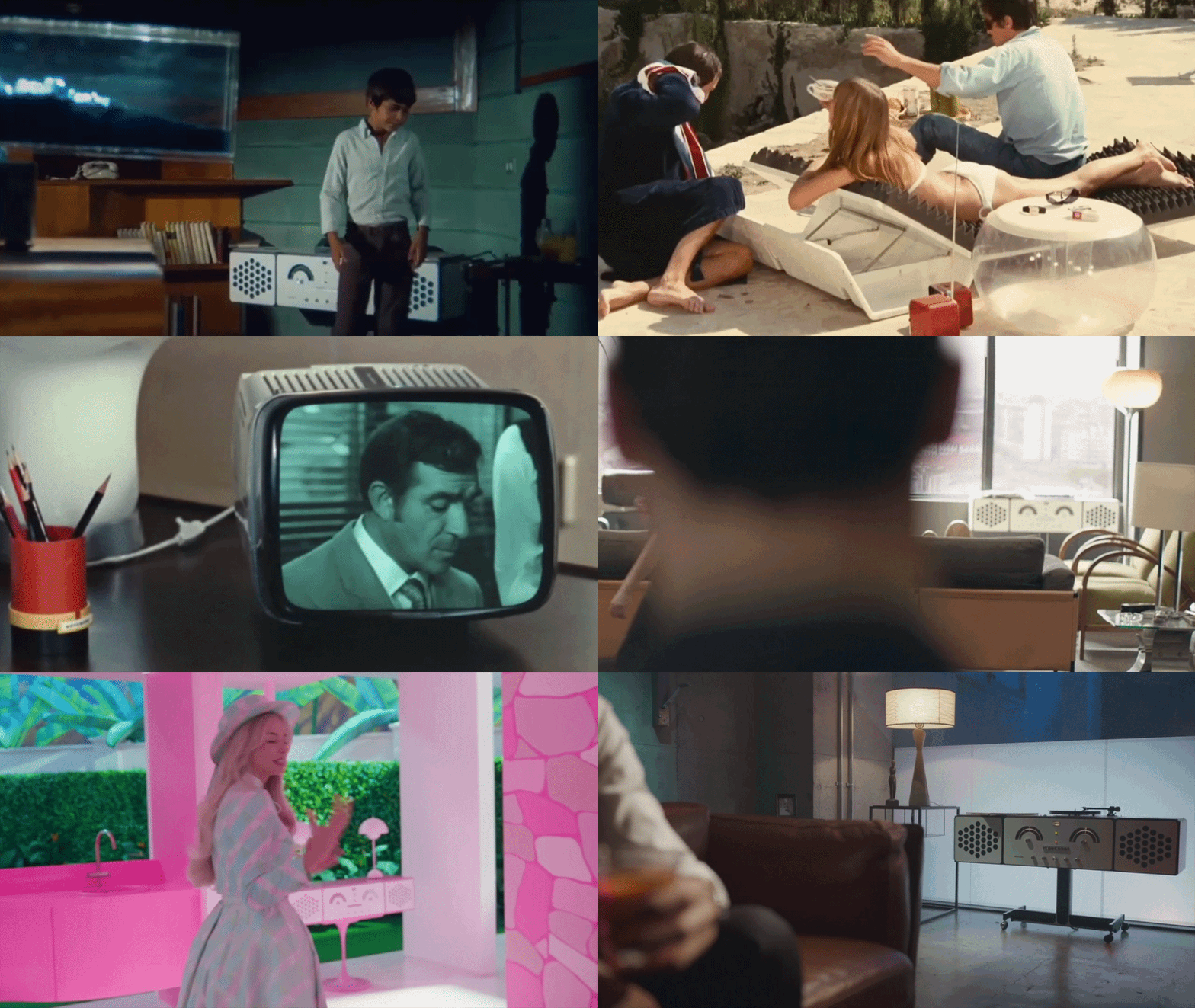
*Frames from, in order of appearance:
Don’t Torture a Duckling (Lucio Fulci, 1972) · La Piscine (Jacques Deray, 1969) · Sissignore (Ugo Tognazzi, 1968) · 1992, series (Giuseppe Gagliardi, 2015)· Io sono Mia (Riccardo Donna, 2019) · Barbie (Greta Gerwig, 2023) · Meibaza, series (Hiromi Kusaka, 2024)
Why these objects?
Because they were designed to be looked at, not hidden. The Radiofonografo has a face, with eyes, ears and a smile, so much so that it looks like a small musical robot; its speakers detach and turn towards the listener. When closed, the radio.cubo keeps its function like a secret. Mario Bellini’s Totem opens up and lays out sound across the room.
They are objects born in electronics that behave like sculptures. In a shot they are never simply background: they play a part without saying a word.
There is a deeper reason too.
Almost every electronic device ages with its technology: when the way we listen changes, its form changes or disappears as well. Brionvega objects followed a different path, because their form was never just a casing for a technique. It was an idea in its own right, drawn by authors.
The technology inside has been renewed. The face has stayed.
This is how they enter the visual memory of those who watch, and remain there.
Those who make cinema have recognised it. During a visit to the production site, Francis Ford Coppola left these words: “Brionvega was always a fascination for me over the years, always admiring the innovative design and effective performance of their products.”
The bond did not end in the Seventies. In Riccardo Donna’s Io sono Mia, in 2019, the Radiofonografo built today plays the one from back then: the same form, the same gesture, made by hand in Italy through twelve stages of production.
The shift is subtle but decisive. On screen there is no antique found to recreate the years in which the film is set: there is the same design, still in production.
In recent years, something more has happened. Brionvega design has stopped serving only to evoke an era and has become a way to build a world.
The Radiofonografo enters the universe of Greta Gerwig’s Barbie, in 2023, a film in which every element helps build an imaginary world and every object speaks of taste, desire and identity. In Korea, the Netflix series The Trunk places it, in white, inside a modern and minimal interior, where the simplicity of the space makes its presence stand out even more: the Radiofonografo does not blend into the room, it defines it.
In Japan, Glass Heart, the 2025 Netflix series about a band and its music, once again chooses the Radiofonografo as part of the scene: an object that needs no explanation to convey, at once, an idea of culture, music and style.
Three productions far apart in language, audience and genre. Three different worlds. And the same object.
Brionvega is not used simply to tell the past. It is chosen to build the present: to define a space, suggest a character, give shape to an idea of life.
Away from the set, there is only one difference: at home, these objects do not act. They play every day, move from one room to another, pass from hand to hand and from one generation to the next, carrying the marks of those who lived with them.
And perhaps this is the point.
Some objects come back out of nostalgia; others come back because an era comes back into fashion.
Brionvega does not really belong to either.
Its objects have crossed the decades without ceasing to be themselves. They did not need to change their form to remain desirable, nor to change their language to be contemporary. Their strength lies exactly here: staying true to their own identity while everything around them changed.
This is why cinema keeps choosing them.
Not to remember a time that is gone, but because some objects have the rare ability to pass through time without belonging to it.
Brionvega on set: a selection
- The 10th Victim (La decima vittima), Elio Petri, 1965
- The Seed of Man (Il seme dell’uomo), Marco Ferreri, 1969
- Sissignore, Ugo Tognazzi, 1968
- La Piscine, Jacques Deray, 1969
- Investigation of a Citizen Above Suspicion, Elio Petri, 1970
- Don’t Torture a Duckling, Lucio Fulci, 1972
- Conversation Piece, Luchino Visconti, 1974
- Fico d’india, Steno, 1980
- Mia moglie è una strega, Castellano e Pipolo, 1980
- Fantozzi contro tutti, Neri Parenti and Paolo Villaggio, 1980
- Mani di fata, Steno, 1983
- Romanzo criminale, series, Stefano Sollima, 2008
- 1992, series, Giuseppe Gagliardi, 2015
- Io sono Mia, Riccardo Donna, 2019
- Made in Italy, series, Luca Lucini and Ago Panini, 2019
- Se mi vuoi bene, Fausto Brizzi, 2019
- Ero in guerra ma non lo sapevo, Fabio Resinaro, 2022
- Il mammone, Giovanni Bognetti, 2022
- The Hummingbird (Il colibrì), Francesca Archibugi, 2022
- Barbie, Greta Gerwig, 2023
- The Trunk, Netflix series, 2024
- Meibaza, series, Hiromi Kusaka, 2024
- Alien: Earth, series, Noah Hawley, 2025
- Glass Heart, Netflix series, 2025
- Agata Christian – Delitto sulle nevi, Eros Puglielli, 2026
